Real Jobs of the Future Report
1 May 2026
How Australians are rethinking work, wellbeing, and the future of jobs
New data from life insurance provider Real Insurance reveals how Australians are rethinking work in 2026, as cost-of-living pressures, AI disruption, and shifting expectations around flexibility reshape career priorities. From the rise of side hustles to growing demand for life–work balance, the Real Jobs of the Future Report 2026 highlights how Aussies are adapting to a rapidly changing employment landscape. This report forms part of the ongoing Real Insurance Research Series exploring the realities of modern Australian life. Based on a nationally representative survey of over 5,000 Australians, it uncovers how workers are balancing financial pressures, wellbeing, and future uncertainty.
Key findings
- Nearly 3 in 5 (59%) Australians would accept lower pay to improve wellbeing
- 89% say flexibility and autonomy are more important than five years ago
- 36% worry AI could replace key tasks within the next decade
- 44% have stayed in a job longer than they wanted due to financial pressure
- 66% expect to have multiple careers over their working life
- 63% are interested in starting a side hustle or small business
- 39% feel unprepared for major changes in the future of work
Wellbeing is becoming the new career currency
For many Australians, career decisions are no longer driven solely by salary.
Nearly 3 in 5 (59%) say they would accept lower pay to reduce their work hours and improve their wellbeing, while over 3 in 4 (76%) believe mental health and wellbeing are now central to career choices.
This shift is particularly strong among younger Australians, with 65% of Gen Z and 64% of Gen Y more willing to trade income for better balance.
There is also strong support for structural change in how work is organised:
- 4 in 5 (80%) support a shift towards ‘life–work balance’
- 2 in 3 (66%) find a four-day workweek appealing
- 64% support a formal ‘right to disconnect’ law
Flexibility is no longer seen as a perk – it’s becoming an expectation.
The impact of AI: opportunity and uncertainty
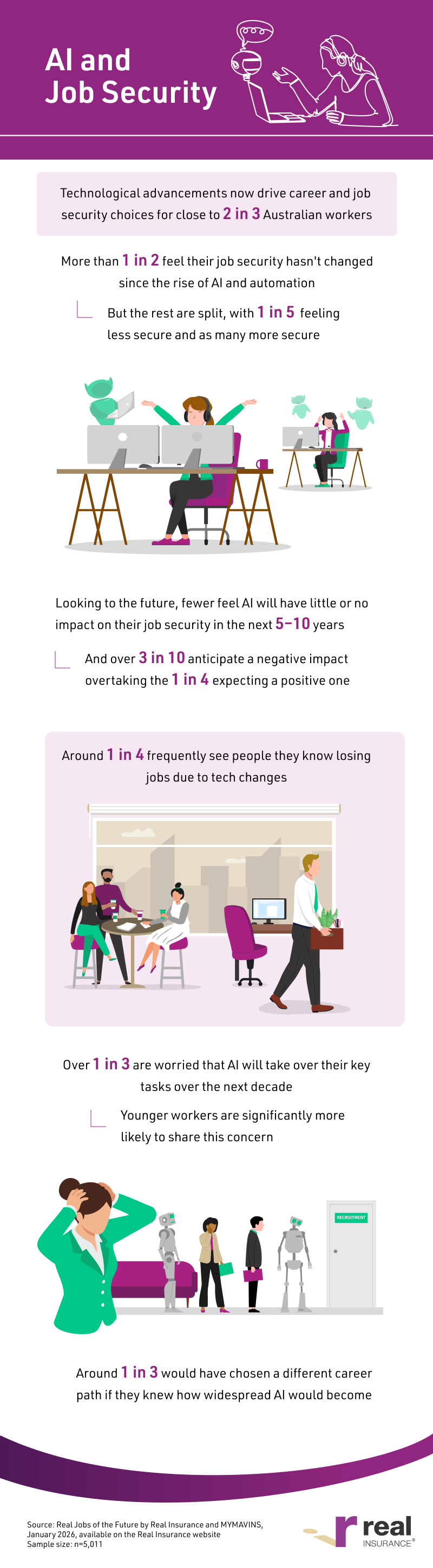
AI is already reshaping the workplace, but its impact is mixed.
While nearly half (45%) of Australians say AI has had no impact on their current role, and 38% report a positive impact, the emotional response is more complex.
Nearly 2 in 3 (64%) workers say they have experienced at least one negative emotional impact from AI at work, with common concerns including:
- Reliability and accuracy (27%)
- Reduced human interaction (22%)
Job security is also a concern, with more than 1 in 3 (36%) worried that AI could replace key tasks in their role within the next decade.
In response, many are adapting:
- 44% have upskilled or reskilled in the past year
- 63% of parents are concerned about their children’s future job security
AI is driving both productivity gains and uncertainty.
Cost-of-living pressures are shaping career decisions
Financial pressure is playing a major role in how Australians approach work.
- 62% are concerned the cost of living will rise faster than wages
- 44% have stayed in a job longer than they wanted due to financial pressure
- 66% say rising costs have reduced their willingness to take career risks
These pressures are shifting priorities from ambition to stability, with many Australians focusing on financial security over career progression.
The rise of side hustles and multiple income streams
To manage financial pressure, many Australians are turning to alternative income sources.
Over 3 in 5 (63%) are interested in starting a side hustle or small business, rising to:
- 75% of Gen Z
- 72% of Gen Y
Already, around 2 in 5 (40%) have taken on additional income sources, primarily to:
- Manage increased living costs (48%)
- Improve financial security (45%)
Side hustles are becoming a key strategy for financial resilience.
The shift towards fluid careers
The concept of a single, lifelong career is becoming less common.
Around 2 in 3 (66%) Australians expect to have multiple careers or significantly different roles throughout their working lives.
This shift is reflected in behaviour:
- 86% have explored or would consider non-traditional work
- 80% say location flexibility is important
Careers are becoming more flexible, more dynamic, and more personalised.
Generational shifts are reshaping the workplace
As expectations evolve, generational differences are becoming more visible.
- 39% feel they must compromise their values to progress in their careers
- This rises to 47% for Gen Z and 42% for Gen Y
- 79% say Gen Z expectations clash with traditional workplace norms
- 47% believe workplaces don’t understand Gen Z
Younger workers are pushing for change, particularly around flexibility, purpose, and career growth.
Are Australians ready for the future of work?
Despite adapting in many ways, many Australians feel unprepared.
Close to 2 in 5 (39%) say they are not ready for major changes in the future of work.
When asked what would help, Australians highlighted:
- Income protection or financial safety nets (48%)
- Fully funded or subsidised training (41%)
- Flexible upskilling opportunities (40%)
Responsibility is seen as shared:
- Government (67%)
- Employers (57%)
- Individuals (46%)
What does the future of work look like?
The future of work in Australia is being shaped by several overlapping forces:
- Economic pressure
- Technological disruption
- Changing expectations around wellbeing
- The decline of traditional career paths
Australians are adapting – but uncertainty remains.
How individuals, employers, and policymakers respond will determine how successfully Australians navigate this transition.
Methodology
Findings in this article are drawn from the Real Jobs of the Future Report 2026, based on a nationally representative survey of 5,011 Australian adults. The research was conducted online using demographic stratification to ensure results reflect Australia’s population by age, gender, wealth, and location.
Q&A Roxanne Hart
What legal protections does the “right to disconnect” law offer employees regarding contact outside work hours?
The right to disconnect laws commenced in Australia on 26 August 2024, except for small businesses (being those with less than 15 employees), in respect of which the laws commenced on 26 August 2025.
The right to disconnect is contained in section 333M Fair Work Act and all Awards, and creates a right for employees to refuse to monitor, read or respond to contact from their employer (as well as clients/suppliers of the employer) outside of the employee’s working hours, unless the refusal is “unreasonable”. Whether a refusal is unreasonable depends on factors such as the reason for the contact, how it is made, the level of disruption caused to the employee, and whether the employee is compensated for working additional hours outside their normal working hours. Disputes about whether an employee’s refusal is unreasonable or not can be resolved by application to the Fair Work Commission.
In my view, outside of working hours contact is only likely to be reasonable where:
- It is infrequent;
- It is an emergency;
- The employee is in a senior position of a nature where contact outside of ordinary hours would be expected; or
- The employee is paid sufficiently above-Award so as to cover the cost of the employee’s time in reviewing and responding to the contact. The employee’s employment contract would also need to refer specifically to this.
Given that the right to disconnect is still relatively new, there has not yet been any cases testing the interpretation and application of the laws or what constitutes “unreasonable” contact. The Fair Work Commission will commence a review of the new laws to consider if they are meeting the Government’s objectives towards the end of 2026.
If my job becomes redundant due to AI or automation, what are my legal rights?
Firstly, you should review your Enterprise Agreement or Award, if one applies to your work. All Enterprise Agreements and Awards contain a consultation provision requiring your employer to consult with you on major workplace changes, which can be triggered by a redundancy. In order for a redundancy to be classified as a “genuine redundancy” under the Fair Work Act, an employer must comply with any such requirements in an Enterprise Agreement or Award.
Your Enterprise Agreement or Award may also include additional rights and redundancy pay over and above the minimum rates.
Otherwise, you may be entitled to redundancy pay as set out in the National Employment Standards (contained inside of the Fair Work Act). To be eligible, you would need to have at least 12 months of continuous service with the employer. Redundancy pay is not payable if the employer is a small business (being less than 15 employees), unless your Award or Enterprise Agreement says otherwise.
In addition, upon termination, the employer must pay you any accrued annual and long service leave and give you notice of termination (or payment in lieu of notice).
A redundancy will not be genuine if it would have been reasonable for the employer to redeploy you elsewhere in their business or with any of their related entities. So if there were other jobs available which you could perform, it may not have been reasonable for the employer to terminate you.
If you are concerned that your redundancy is not genuine, you may consider making an unfair dismissal application. If an employee has been targeted for redundancy in circumstances that are discriminatory (for example, because they have a disability or have made workplace complaints), they may consider making a general protections application.
As such, it is important for employers to ensure that they are not biased during the redundancy process and are not acting in retaliation.
What are the key legal considerations for Australians starting a side hustle, especially if they're also employed full-time?
Employees considering starting a side hustle, or even taking a second job, should first look at their employment contract to see whether it contains any restrictions. Some employment contracts require employees to disclose if they are engaging in any other businesses. There may be reasons why your employer needs to know this (for example, due to regulatory requirements in certain industries), particularly if there could be an actual or perceived conflict of interest between your job and the side hustle/second job. Even if the employment contract does not include such restrictions, there can be other benefits to discussing the proposal with your employer including:
- It can avoid an awkward situation in future; and
- You can clarify that any IP created in the side hustle remains your property. We have seen cases where employees have engaged in a side hustle involving the creation of technology and that technology could be used by their employer’s business. There have then been arguments that the technology created is actually the employer’s property, even if it is developed outside of working hours.
You should also ensure that you are not working on your side hustle during working hours. This would constitute a breach of your employment contract with your employer which typically requires you to devote all of your time during work hours to the company.
There was a case several years ago where an employee started a candle making business outside of work however responded to customers, took phone calls and made social media posts for her business during working hours. She was dismissed. While she ultimately succeeded in her unfair dismissal application due to procedural deficiencies during the termination process, the Fair Work Commission confirmed that the employer nevertheless had a valid reason for dismissal.
My new employer has agreed that I can work from home 2 days per week however this is not included in my employment contract, is there anything I should do?
I have seen a number of cases where employees have accepted a new role on the basis that they will work a certain number of days remotely. This is typically discussed verbally and/or via email, however is not included in the employment contract. If the right is not included in the employment contract and the contact instead states that the employee will work from the location determined by the employer (as contracts commonly do), then the employee must typically comply with the employer’s direction to return to the office. This was reaffirmed in a recent unfair dismissal case.
As such, if you are negotiating a new employment contract and you have agreed upon a right to work from home, this should be stated in the contract.
I fall into one of the categories that allow me to make a flexible working arrangement request, so does that mean I can request to work from home?
A person is eligible to make a flexible working arrangement if they have worked for their employer for at least 12 months and fall into one of the following categories:
- the parent, or have responsibility for the care, of a child who is school aged or younger
- a carer (under the Carer Recognition Act 2010)
- a person with disability
- 55 or older
- pregnant
- experiencing family and domestic violence
Importantly, the request for the flexible working arrangement must be made because the employee falls into one of these categories.
There have been a number of cases which have made the news recently concerning employees who make a request for a flexible working arrangement in order to work remotely. The key takeaway from these cases is that whilst an employee may fall into one of the categories set out above and therefore appear eligible to make a request, they can only make the request if it is because of the circumstance listed. For example, in one case an employee of Westpac was granted the right to continue to work from home in order to manage school pick up and drop offs for her two young children. The reason that she made the request was therefore because of her position as a parent of the children. In another case, an employee who was the parent of school age children asked to work remotely from a different State because they wanted to move State due to her husband’s work. In that case, the reason for the request was to support the husband’s work and was not due to the employee being a parent of school age children. As such, the Fair Work Commission rejected her application.
*Please note that these answers refer to the Fair Work Act, which applies to most employees in Australia. For those not covered by the Fair Work Act, such as employees of certain State/Local Governments, equivalent rights may exist in your State’s industrial relations laws.
Download full research report


