Real Separation Report 2026
15 Jun 2026
How Australians are navigating separation, finances, and life after divorce
New data from life insurance provider Real Insurance reveals how Australians are navigating separation and divorce in 2026. From efforts to repair relationships to the financial realities and emotional recovery that follow, the Real Separation Report 2026 explores the hidden journey of uncoupling in modern Australia.
Based on a nationally representative survey of over 1,200 Australians who have separated or divorced, the report highlights the complex mix of emotional, financial, and practical decisions that shape the separation experience.
Key findings
- Nearly 3 in 5 (56%) Australians tried to make their relationship work before separating
- Over 3 in 5 (61%) did not use couples counselling or relationship support services
- Nearly 1 in 2 (48%) made quiet financial moves prior to separation
- 7 in 10 (70%) delayed separation for various reasons
- 1 in 3 (35%) found the cost of separation higher than expected
When do you know it’s time to separate?
Before the final split, many Australians put considerable effort into mending their relationships. Nearly 3 in 5 (56%) of those who separated or divorced seriously considered ending things but chose to try and make it work instead.
This effort is particularly strong among younger Australians, with 3 in 4 (75%) Gen Y and over 7 in 10 (71%) Gen Z attempting to repair their relationships, compared to just 43% of Baby Boomers. These younger generations show a greater willingness to invest in relationship repair, even if it means prolonging a difficult period.
Despite this, professional support is often overlooked. Over 3 in 5 (61%) Australians did not use couples counselling or relationship support services before separating. While Gen Z is more likely to seek support, a majority still navigate these moments without professional guidance.
Interestingly, those without children were less likely to try and repair the relationship, with around 2 in 5 (38%) saying they made the effort, compared to 58% of those with children. This suggests that children can be a powerful motivator for couples to persevere.
Elise Fordham, Principal Lawyer at Hitch Advisory, says early intervention, even if not formal counselling, can set a more amicable tone for future legal discussions if separation becomes inevitable.
“Deciding to separate is rarely a single moment; it’s often a gradual realisation that builds over time. Seeking individual or couples counselling early can help you process these feelings, protect your mental health, and gain clarity on whether the relationship can be repaired or if separation is the best path forward.”
“An amicable separation, while not always possible, generally leads to an easier experience in every respect; legally, financially, and emotionally. When both parties can communicate respectfully and work towards sensible outcomes, it reduces legal costs, shortens timeframes, and creates a healthier environment for everyone involved, especially children who absorb everything they see and feel from their parents.”
The rise of ‘quiet separation’
The path to separation is rarely sudden. Instead, it is often a gradual process of emotional and practical detachment that unfolds long before any formal decision is made.
Many couples begin living separate lives while still under the same roof. Around 1 in 2 (51%) reported sleeping in separate bedrooms, and 47% were already living largely independent lives before formally separating.
This shift often extends to finances. Over half (53%) had already begun managing their money separately, while nearly 1 in 2 (48%) made quiet financial moves such as building personal savings or avoiding shared purchases due to uncertainty about the relationship.
This behaviour is particularly common among younger Australians. Over 7 in 10 (71%) Gen Y had separated finances before the split, compared to around 2 in 5 (41%) Baby Boomers. In contrast, almost 7 in 10 (69%) Baby Boomers reported making no financial moves at all.
Elise Fordham says these 'quiet moves' can sometimes have unforeseen legal implications regarding property and financial separation, even if made with good intentions.
“For some people, making quiet financial moves before separation is about survival. It can provide the security needed to leave a relationship without the paralysing fear of financial instability. Having funds set aside means you can cover immediate costs like a rental bond, removalists, or legal advice without being trapped in a situation that’s no longer working.”
Why do Australians delay separation?
The decision to separate is rarely immediate. Around 7 in 10 (70%) Australians delayed their separation, often for a combination of emotional and practical reasons.
The most common factors include:
- Hope the relationship would improve (36%)
- Concern for children (34%)
- Emotional readiness or uncertainty (23%)
- Financial concerns and cost-of-living pressures (23%)
Children play a particularly significant role. More than 2 in 3 (68%) parents stayed in their relationship longer than they wanted because of their children. This was especially pronounced among women, with over 1 in 3 (35%) saying they stayed to a great extent.
Among those who delayed separation due to children, just over half (51%) stayed at least a year longer, and 3 in 10 (31%) remained for more than two years.
However, once the decision is made, separation often happens quickly. Close to 3 in 5 (56%) said the time between seriously considering separation and formally separating was one year or less.
While emotional factors often delay separation, Elise Fordham says understanding legal rights and obligations early can reduce future complexity, especially when children are involved.
“Delaying separation isn’t always about indecision. Delaying can be a strategic choice. For many people, that extra time allows them to prepare to leave safely and with greater ease. It’s an opportunity to get your ducks in a row, emotionally and practically, so that when the time comes, you’re ready.”
The financial reality of separation
While the emotional toll is significant, the financial impact of separation is often underestimated.
Over 1 in 3 (35%) Australians said the cost of separation or divorce was higher than expected. For those who paid for legal advice, the average cost was around $7,481, making it the largest single expense.
However, around 1 in 2 (53%) paid nothing for legal support, highlighting the variability in how Australians approach separation.
Other costs included:
- $944 for counselling or support services
- $1,377 for mediation or dispute resolution
- $1,624 for financial advice
- $1,107 for divorce application and filing costs
- $5,598 for implementing asset division
Unexpected costs were often the most challenging. These included increased living expenses such as rent and utilities (32%), and the cost of setting up separate households (30%).
Legal costs and loss of shared income were unexpected for around 1 in 5 (19%), while debt repayments, child-related costs, and ongoing financial support were also cited by many.
Younger Australians and those who experienced more difficult separations were more likely to face these financial pressures.
Elise Fordham says many Australians underestimate both the financial and emotional costs of separation, particularly when legal disputes become prolonged or high-conflict.
“Understanding the true cost of separation (both financially and emotionally) is essential. But it’s equally important to understand the cost of not getting proper advice. A well-structured agreement that protects your interests is worth the investment, especially when the alternative could be years of uncertainty or a settlement that leaves you significantly worse off.”
“The difference in cost between reaching a simple agreement early and going to court can be staggering. A negotiated settlement might cost a few thousand dollars, while contested court proceedings can easily run into tens of thousands and drag on for one to two years. The financial and emotional toll of litigation is something I encourage everyone to consider carefully before heading down that path, however for some people it is unavoidable to ensure they receive what they’re legally entitled to, and the cost of pursuing that is far less than their entitlements.”
What happens after separation?
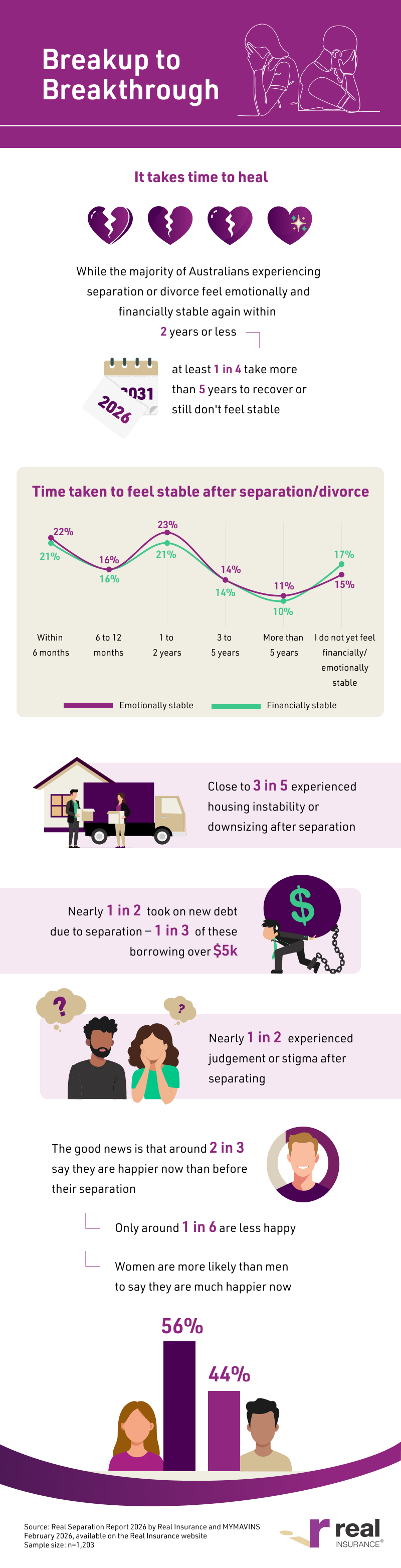
The period after separation is critical for rebuilding stability. Nearly 2 in 5 (38%) regained financial stability within a year, with 21% doing so within six months. A similar proportion achieved emotional stability within the same timeframe.
However, recovery is not always quick. Around 1 in 6 (17%) still feel financially unstable, and 1 in 7 (15%) continue to struggle emotionally.
Separation often brings broader life changes. Close to 3 in 5 (56%) experienced housing disruption or downsizing, and nearly 1 in 2 (45%) took on new debt, including 17% who accumulated more than $20,000.
Social impacts are also significant. Almost half (47%) reported experiencing judgement or stigma following their separation, particularly among younger Australians.
Despite these challenges, outcomes are often positive over time. Around 2 in 3 (66%) say they are happier now than before their separation, with 1 in 2 (50%) saying they are much happier.
For parents, relationships with children can also improve, with nearly 1 in 3 (30%) reporting a stronger bond post-separation.
Elise Fordham says the way separation unfolds can have a major impact on long-term emotional and financial recovery.
“How the separation occurs has a direct impact on the emotional burden that follows. A high-conflict split often leaves people carrying anger, resentment, and stress long after the split. On the other hand, those who manage to separate respectfully tend to recover emotionally much faster.”
“Delays in formalising property and parenting arrangements can significantly extend the period of instability. When agreements are left open-ended or informal, it creates ongoing uncertainty that affects housing decisions, financial planning, and even your ability to move forward emotionally. Finalising these arrangements provides the closure needed to truly start rebuilding all aspects of your life.”
Advice from those who’ve been there
Looking back, nearly 1 in 2 (48%) Australians say they would approach their separation differently if given another chance.
The most common things people wish they had known include:
- The emotional and mental health impact (35%)
- The impact on children (31%)
- The true cost of separation (26%)
- Housing and living arrangement challenges (25%)
Two key themes emerge in advice to others:
- Take time to think through the decision carefully (26%)
- Act promptly once the decision is clear (24%)
Other advice includes prioritising wellbeing (18%), attempting repair first (10%), ensuring financial readiness (9%), and planning for children (8%).
Methodology
Findings in this article are drawn from the Real Separation Report 2026, based on a nationally representative survey of 1,203 Australians who have separated or divorced. Conducted as part of the Real Insurance Research Series, the study explored experiences across relationship repair, separation timing, financial impacts, and post-separation recovery. Data was collected via an online survey, with weighting and stratification applied to reflect Australia’s population by age, gender, wealth, and location.

Elise Fordham, Principal Lawyer – Hitch Advisory
Elise Fordham is a Principal Lawyer at Hitch Advisory and is admitted to the High Court of Australia. She holds a Bachelor of Financial Administration (Accounting), a Bachelor of Laws, and a Graduate Diploma in Legal Practice.
Elise brings a rare combination of legal precision, financial acumen, and genuine human compassion to every matter she handles. She understands that family law proceedings are rarely just legal disputes - they are among the most profound and life-altering experiences a person can face. Elise is deeply committed to guiding her clients through these moments with sensitivity, clarity, and unwavering support, ensuring they feel heard, protected, and empowered at every stage of the process.
Download full research report


