Real Legacy Report 2026
25 Sept 2026
How Australians are rethinking inheritance, Wills, and digital legacy
Our lives are more online, and more financially complex, than ever before. We share photos, message loved ones, rely on family to help break into the housing market, and build entire communities on the internet. But have you ever stopped to think about what happens to it all when you’re no longer here?
New data from life insurance provider Real Insurance reveals how Australians are thinking about the legacy they leave behind – from inheritance and family wealth to Wills, social media accounts, and our growing digital footprint.
Based on a nationally representative survey of more than 1,200 Australians, the Real Legacy Report 2026 explores the gap between our intentions and actions when planning for the future, including attitudes towards the "Bank of Mum and Dad", intergenerational wealth, and what happens to our digital lives after death.
Key findings
- Over 7 in 10 (73%) Australians expecting an inheritance say family help is important for buying property, yet over 3 in 5 (61%) want their parents to spend their money in retirement.
- Nearly half (49%) of those expecting or relying on an inheritance admit to feeling guilty about it.
- Nearly 3 in 5 (58%) have no idea about social media legacy settings, and 77% have never discussed their digital afterlife.
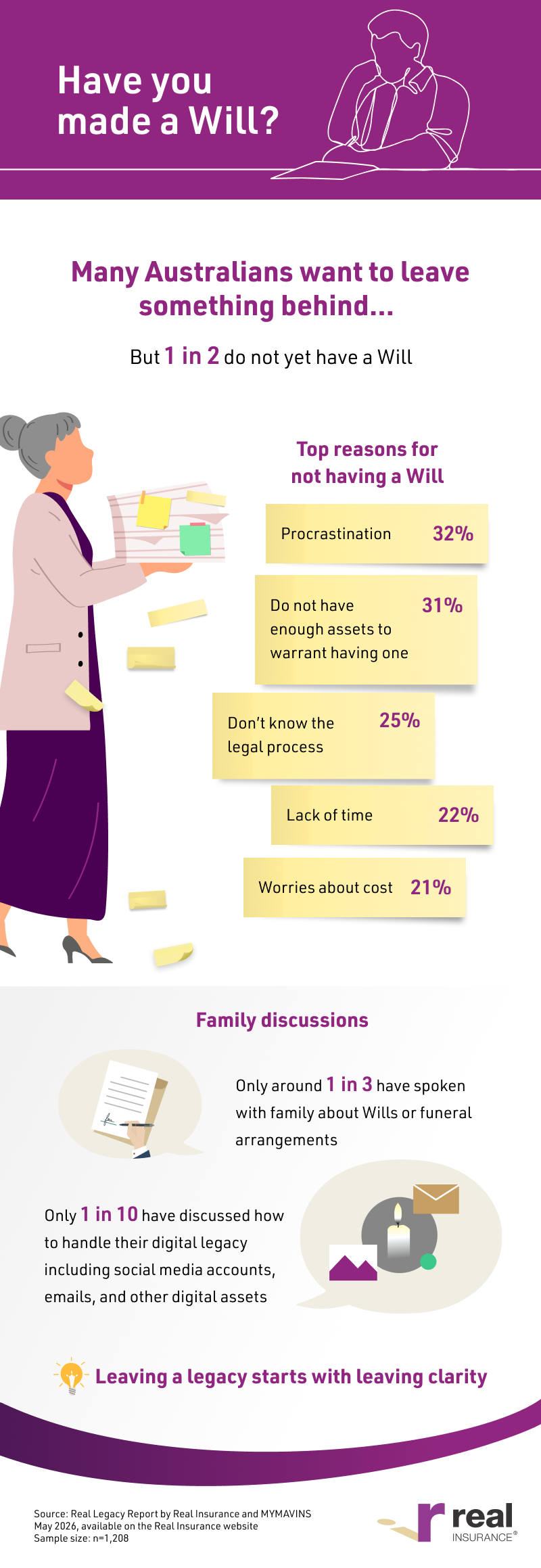
- Half (50%) of Australians do not have a Will in place.
- Half (50%) believe children who care for ageing parents should receive a larger share of the estate.
The inheritance paradox – property versus retirement
When it comes to money, Australian families are navigating a complex and often stressful divide.
Rising living costs and housing pressures have made family support increasingly important, with over 7 in 10 (73%) of those expecting an inheritance saying family help is important for affording a property.
Yet that doesn't mean Australians want their parents to sacrifice their retirement to provide it. More than 3 in 5 (61%) support their parents spending their retirement money and enjoying themselves.
This creates an inheritance paradox – younger generations may increasingly see family wealth as important to achieving major financial milestones, while simultaneously wanting their parents to enjoy the money they've worked to build.
That tension can carry an emotional cost. Nearly half (49%) of Australians expecting or relying on an inheritance say they often or sometimes feel guilty about it. The same proportion (49%) report feeling judged or uncomfortable when asking family for financial help.
Ideas about what constitutes a "fair" inheritance are changing too. Half (50%) of Australians believe children who act as caregivers for ageing parents should receive a larger share of the estate, challenging the traditional expectation that an inheritance should always be divided equally.
What happens to our digital lives after death?
Photos, messages, social media profiles, playlists, emails, and online accounts now form a significant part of our lives. Yet many Australians have given little thought to what should happen to this digital footprint after they die.
Nearly 3 in 5 (58%) say they don't know about legacy settings available on platforms such as Facebook and Instagram. These tools can allow people to nominate what happens to an account after death, including whether it is deleted or memorialised.
The conversation is largely being avoided too. More than three-quarters (77%) have never discussed what should happen to their digital lives after they die.
Without a plan, responsibility can fall to loved ones at an already difficult time. Australians say some of the hardest tasks would be sorting through a deceased person's photos (36%) and reading their personal messages (34%), while 28% worry about discovering something they weren't expecting to find.
As artificial intelligence develops, the idea of a digital afterlife is becoming even more complex. One in 5 (20%) Australians say they would follow, or consider following, the social media account of someone who had died if AI allowed that account to continue posting after their death.
The question of what we leave behind is therefore no longer limited to physical possessions or financial assets – increasingly, it includes our digital identity too.
What does leaving a legacy mean to Australians?
The meaning of "legacy" differs considerably across generations.
For Baby Boomers, legacy is most closely associated with leaving behind money, property, and other financial assets (58%).
Gen Y places greater emphasis on emotional legacy, including being remembered positively (50%) and passing on personal values (42%).
Gen Z has another perspective again, with career achievements (25%) and sustainability efforts (19%) playing a greater role in how they think about what they will leave behind.
These differences suggest that the traditional idea of legacy as something measured primarily through wealth and possessions is evolving. For many Australians, memories, values, achievements, and digital traces are becoming an important part of what it means to leave something behind.
Why don't half of Australians have a Will?
A Will can play an important role in determining how someone's wishes and assets are handled after their death. Yet the report found that half (50%) of Australians don't currently have one in place.
For many, putting it off is the biggest barrier. Procrastination is the most common reason (32%), followed closely by feeling they don't have enough assets to justify having a Will (31%). A quarter (25%) say they simply don't understand the legal process.
However, concerns about what could happen without clear instructions are widespread. Almost 1 in 3 (31%) Australians are worried their family could argue over their estate.
A Will isn't only about money or property. It can provide clear instructions about a person's wishes and help reduce the number of difficult decisions loved ones may need to make during an already challenging time.
From financial assets to sentimental possessions, planning ahead can help make those wishes clearer and give families a roadmap for what happens next.
Taking control of your legacy
The research highlights a common thread across inheritance, Wills, and digital legacies – many Australians have strong views about what they want, but haven't necessarily communicated or formalised them.
Open conversations can be an important first step. Talking about financial wishes, treasured possessions, online accounts, photos, and digital memories may feel uncomfortable, but it can give loved ones greater clarity about what matters.
Planning a legacy doesn't need to mean resolving everything at once. It can begin with understanding what you want to leave behind – including the memories, stories, values, finances, and digital traces that collectively tell the story of your life.
How to start a conversation about digital legacy and end-of-life planning
We asked Associate Professor and digital legacies expert Bjorn Nansen for his advice on starting conversations about legacy and end-of-life planning with family.
1. Use a conversation that's already happening
A funeral experience, celebrity death, or news story about digital remains can provide a natural opening to discuss the personal or social consequences of not planning a digital legacy. Starting with someone else's story can feel easier than immediately talking about your own death.
2. Make it an ongoing conversation
You don't need to cover everything in one sitting. A conversation that starts over dinner or during a long drive can continue over weeks or months. Many people find it easier to revisit the topic gradually than treat it as one big, formal discussion.
3. Start with memories and meaning, not death or inheritance
These conversations don't have to begin with death. They can start with a favourite song, treasured photo, family story, or a question about which parts of our increasingly digital lives are worth remembering and preserving.
Questions such as "Which photos would you never want to lose?" or "What songs would have to be played at your funeral?" can open broader discussions about digital memories and what matters most.
4. Talk about the significance of the traces we leave behind
Our digital lives extend beyond photos and documents. Music playlists, podcast histories, search histories, and other behavioural data can tell stories about who we are.
Questions such as "Would you want your family to have access to that information?" or "What part of your digital life has the most meaning?" can provide useful conversation starters.
5. End with one practical step
Doing nothing can leave an emotional burden for others, so framing legacy planning around family heritage or reducing future stress may make the conversation easier.
Once you've talked, choose one simple action to get started – write down important accounts, nominate a trusted person who knows where passwords are securely stored, or explore digital legacy planning resources.
The goal isn't to solve everything at once. It's to start.
What will your legacy look like?
The report shows that what Australians leave behind is becoming more complicated.
Inheritance remains important as younger generations face growing financial and housing pressures, but many Australians also want their parents to enjoy the wealth they've accumulated. At the same time, the rise of social media and AI means our digital lives are creating an entirely new category of legacy that many of us have barely begun to plan for.
Whether it's financial assets, family memories, personal values, or an online footprint, thinking about what happens to the things that matter to us can make the future clearer for the people we leave behind.
Methodology
Findings in this article are drawn from the Real Legacy Report 2026, which surveyed a nationally representative sample of 1,208 Australians.
The survey was conducted online using demographic stratification to ensure responses reflected Australia's population by age, gender, and location.
For more information and detailed findings, download the full Real Legacy Report 2026 here.
Download full research report
- Real Legacy Report 2026 [PDF]


