Real Modern Family Report 2026
24 Nov 2026
Who really carries the load in Australian families?
Running a household involves much more than the jobs we can see. There are appointments to remember, meals to plan, bills to pay, children to organise and countless decisions that keep family life moving.
But who is actually carrying that load – and what happens when it doesn't feel fairly shared?
New research from Real Insurance reveals how Australian couples and co-parents are navigating the often-invisible responsibilities of modern family life, from household tasks and emotional labour to finances, parenting and personal time.
Based on a survey of more than 1,200 Australians, the Real Modern Family Report 2026 explores what we're calling the “Emotional Economy” – the often-unspoken tally of who remembers, organises and completes household tasks, who carries emotional and parenting responsibilities, and who gives up personal time or career opportunities to keep family life running.
Key findings
- Over 3 in 5 (61%) Australians in couples or co-parenting situations say they are primarily responsible for remembering and organising household tasks.
- Women are nearly twice as likely as men to take primary responsibility for remembering and organising household tasks (81% vs 41%).
- More than 3 in 4 (77%) parents say at least one parenting responsibility became theirs by default rather than through a clear agreement.
- More than 1 in 2 (53%) have hidden a purchase or financial decision from their partner or co-parent at least once.
- Over 2 in 5 (43%) parents have felt lonely or like they're “doing it all alone” within their relationship or co-parenting arrangement at least sometimes.
Who really carries the invisible load?
Managing a household takes a significant amount of behind-the-scenes planning. Over 3 in 5 (61%) Australians in couples or co-parenting situations say they are primarily responsible for remembering and organising household tasks.
Among those whose partner or co-parent isn't always responsible, nearly 3 in 5 (59%) experience decision fatigue at least sometimes.
The responsibility isn't necessarily shared evenly. Women are nearly twice as likely as men to say they are mostly or always responsible for remembering and organising household tasks (81% vs 41%).
The divide extends beyond planning. Women are also nearly twice as likely as men to be primarily responsible for actually completing household tasks (67% vs 34%) and more than twice as likely to take on more of the emotional labour in their household (55% vs 23%).
These pressures can affect relationships too. Over half (53%) say the household mental load has negatively affected their relationship. Among women, this rises to nearly 3 in 5 (59%), with feeling taken for granted (30%), increased stress (29%) and feeling unsupported (24%) among the most commonly reported effects.
Child and Adolescent Psychologist Clare Rowe says the psychological impact can become significant when one person feels responsible for constantly keeping family life moving.
“It’s often not simply the amount of work that causes resentment, but the feeling that the work is invisible or taken for granted. Over time, feeling responsible for keeping everything running can contribute to stress, decision fatigue and a sense that the relationship is no longer operating as a partnership.
“Resentment can build particularly when one person feels they have to continually ask their partner to help, because even delegating tasks becomes another responsibility they have to manage.”
Are parenting roles chosen – or do they just happen?
For many families, responsibilities aren't necessarily divided through a deliberate conversation.
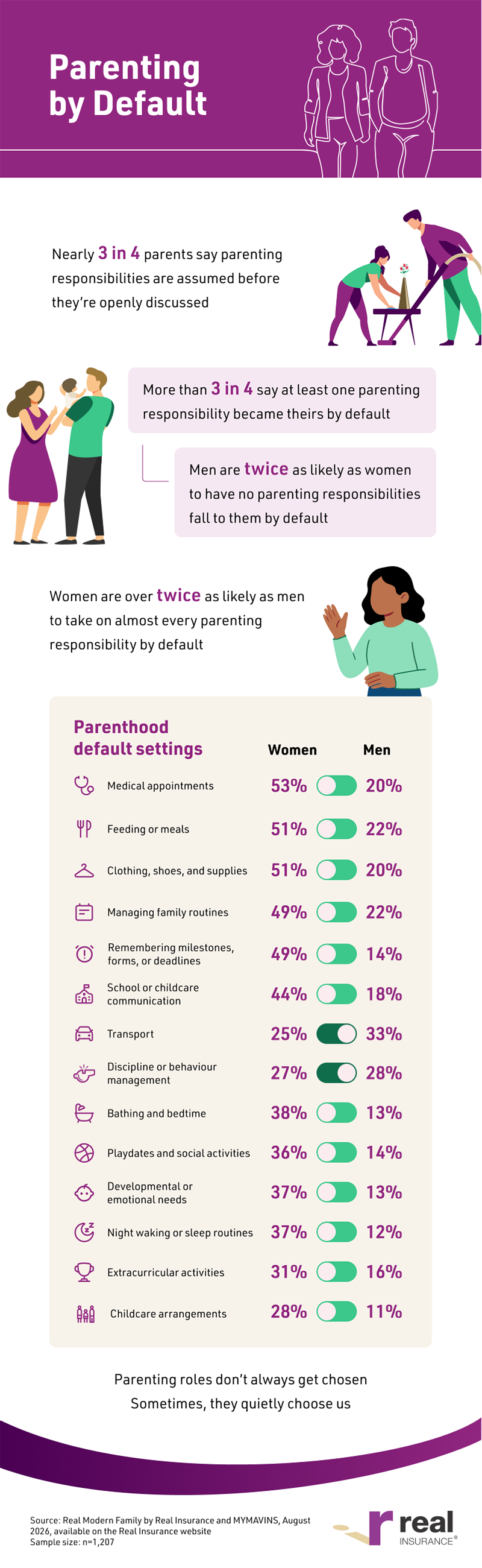
Nearly 3 in 4 (72%) parents say assumptions about parenting responsibilities are made before anyone openly discusses who will take them on. More than 3 in 4 (77%) say at least one parenting responsibility became theirs by default rather than through a clear agreement.
Women are around twice as likely as men to take on almost every parenting responsibility by default, except transport and discipline. Medical appointments (53% vs 20%), meals (51% vs 22%) and clothing, shoes and supplies (51% vs 20%) show some of the largest differences.
Those responsibilities can also spill into other areas of life. Over 3 in 5 (61%) working mothers usually adjust their work commitments for parenting needs, compared with around 1 in 3 (33%) working fathers.
More broadly, over half (55%) of working parents say parenting has negatively affected their career progression or professional ambitions. This rises to 69% among working mothers, compared with 46% of working fathers.
And the effects aren't only professional. Over 2 in 5 (43%) parents have felt lonely or like they're “doing it all alone” within their relationship or co-parenting arrangement at least sometimes, rising to 54% among mothers.
Clare Rowe says conversations about responsibility are most useful before frustration or burnout sets in.
“Couples should regularly look at the whole picture – parenting, household responsibilities, work commitments and personal time – rather than negotiating individual tasks only when something goes wrong.
“Importantly, fairness doesn't always mean doing exactly the same amount. Families go through different stages where one partner may temporarily carry more. The important thing is that these arrangements are discussed rather than assumed, and that neither person's career, wellbeing or opportunities are repeatedly sacrificed simply because a particular role has become ‘theirs’ by default.”
What are financial secrets doing to Australian relationships?
Household responsibilities aren't the only things couples aren't always talking about.
More than half (53%) of Australians in couples or co-parenting situations have hidden a purchase or financial decision from their partner or co-parent at least once.
Among those who have hidden something, over 1 in 3 (36%) concealed a purchase, 3 in 10 (30%) concealed the true cost of a purchase and over 1 in 4 (26%) secretly saved money.
Women and men also report different behaviours. Women are more likely to have hidden purchases (43% vs 29%), while men are more likely to have gambled without their partner's knowledge (24% vs 9%).
These behaviours are occurring alongside broader financial pressures. Over 2 in 5 (43%) say cost-of-living stress has negatively affected their relationship at least sometimes in the past year, rising to 70% among Gen Z respondents.
Income differences can shape household dynamics too. Around 2 in 3 (66%) report an appreciable income difference with their partner or co-parent.
Among Australians who don't earn similar amounts to their partner or co-parent, or are unsure, nearly 1 in 2 (47%) say the lower earner is at least sometimes expected to do more household, parenting, family or emotional labour.
The personal time gap
Time can be another unevenly shared resource within families.
While nearly half (48%) say sacrificing personal time for family or domestic responsibilities is shared equally, women are more than twice as likely as men to say they are the one who sacrifices more personal time (58% vs 23%).
Women are also more likely to say their personal time is interrupted by household or family needs (74% vs 61%).
That imbalance can create resentment. More than half (53%) of women say they feel at least a little resentful of their partner having more leisure time, compared with 37% of men.
Family responsibilities can also reshape longer-term ambitions. Around 2 in 3 (67%) Australians say they have put personal ambitions or passions on hold because of family responsibilities, rising to 77% among parents.
The pressures outside the home
Modern family pressures don't stop at the front door.
More than half (56%) of parents say they are involved in networks connected to their child's daycare, school, extracurricular activities, friendships or chat groups. More than half (52%) say these parent networks create stress, tension or emotional labour.
Judgement is part of that experience too. More than 2 in 5 (43%) parents say they feel judged by other parents for their parenting choices or children's behaviour at least sometimes. At the same time, around 2 in 5 (39%) admit to judging other parents themselves.
Those opinions can even influence children's relationships. Three in 10 (30%) parents have discouraged or limited their child's friendship with another child because of concerns about the other family or parenting environment, while over 2 in 5 (42%) have done so because of concerns about the child's behaviour or influence.
How can couples make the invisible visible?
The report suggests that some of the pressures facing Australian families aren't necessarily caused by one major disagreement. They can develop gradually through responsibilities, expectations and decisions that are never openly discussed.
More than half (52%) say they avoid difficult conversations about money, stress, resentment or household responsibilities at least sometimes.
Making those invisible responsibilities visible can be a useful starting point. Rather than focusing only on who completes individual chores, couples can consider the broader picture – who remembers what needs doing, who organises it, whose time is interrupted and whether both people feel their contribution is recognised.
As Clare Rowe explains, the goal doesn't necessarily need to be a perfectly equal split.
“Couples don't need a perfectly equal division of every task. They do need to feel that their contribution is recognised, that the overall arrangement is fair and that they can tell their partner when they're struggling without it becoming another argument about who does more.”
What does the modern family look like?
There may be no single formula for dividing the responsibilities of family life.
But the research shows how much of that responsibility can remain invisible – from remembering appointments and managing children's needs to making career sacrifices, giving up personal time and navigating financial pressures.
For families, the findings suggest that the conversation isn't necessarily about making every responsibility perfectly equal. It's about making sure those responsibilities are visible, discussed and understood rather than simply becoming someone's job by default.
Methodology
The Real Modern Family Report 2026 was commissioned by Real Insurance and conducted by MYMAVINS.
The findings are based on a quantitative online survey conducted between 22 and 29 June 2026 among 1,207 adult Australians who live with a partner, have a co-parenting relationship, or both. Where a question could apply to either a partner or co-parent, respondents were asked to answer about the partner they live with.
For more information and detailed findings, download the full report here.
Download full research report


